
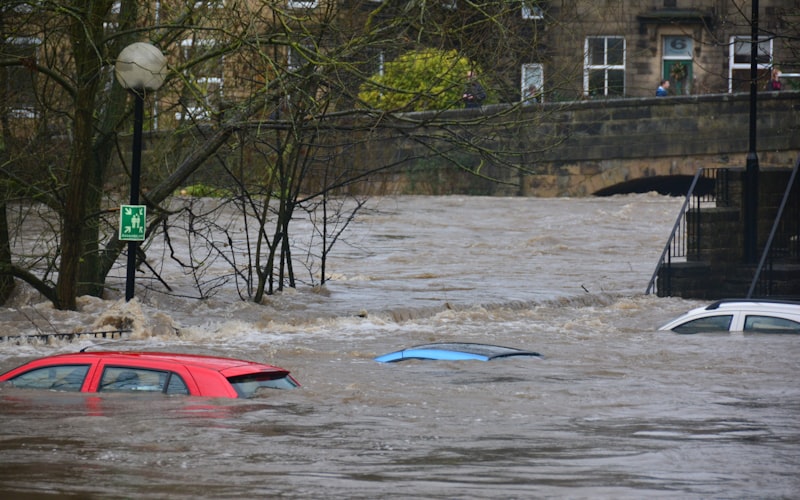
Every year, flooding causes billions of dollars in property damage across the United States. Yet the majority of homeowners don't carry flood insurance, and many don't realize their standard homeowners policy explicitly excludes flood damage. Whether you live in a designated flood zone or not, understanding flood insurance is critical to protecting your home and financial security.
Why Your Standard Homeowners Policy Won't Help
Standard homeowners insurance policies (HO-3) cover water damage from sudden internal events like burst pipes or an overflowing washing machine. However, they universally exclude damage caused by external flooding, including river overflow, storm surge, heavy rainfall accumulation, and snowmelt runoff. This exclusion applies to every major insurance carrier without exception.
The distinction matters enormously. If a hurricane causes wind damage to your roof and rain enters through the opening, your homeowners policy covers that. But if the same hurricane pushes a storm surge that floods your first floor, you're completely unprotected without a separate flood policy. Many homeowners discovered this devastating gap during Hurricanes Katrina, Harvey, and Ian, when billions in flood losses went uncompensated because residents lacked flood coverage.
The National Flood Insurance Program (NFIP)
The federal government created the National Flood Insurance Program in 1968, administered by FEMA, to make flood insurance available to homeowners in participating communities. The NFIP remains the most common source of flood insurance in the country, with over 5 million policies in force.
NFIP Coverage Limits
NFIP policies provide coverage in two categories, each with firm caps:
- Building coverage: Up to $250,000 for residential structures, covering the foundation, electrical and plumbing systems, HVAC equipment, appliances, and permanently installed features like carpeting and cabinets.
- Contents coverage: Up to $100,000 for personal belongings, including furniture, clothing, electronics, and portable appliances. This is purchased separately from building coverage.
- Basement limitations: The NFIP severely restricts basement coverage. Finished walls, floors, and most personal property stored in basements are not covered.
- No loss-of-use coverage: Unlike homeowners insurance, NFIP policies do not pay for temporary living expenses if your home becomes uninhabitable.
NFIP vs. Private Flood Insurance
In recent years, private flood insurance has grown significantly, offering an alternative to the NFIP. Private carriers often provide higher coverage limits, replacement cost valuation instead of actual cash value, loss-of-use coverage, and basement contents protection. Premiums from private insurers can be competitive with or even lower than NFIP rates, especially for homes in moderate-risk zones.
However, private flood insurance may not be available in all areas, and some mortgage lenders are still adjusting to accepting private flood policies to satisfy their lending requirements. Always confirm with your lender before switching from an NFIP policy to a private one.
Flood Zones Explained
FEMA designates flood zones on Flood Insurance Rate Maps (FIRMs) to communicate flood risk across communities. Understanding your zone determines both your insurance requirements and your likely premium costs:
- Zone A and AE (high-risk): These areas have a 1% or greater annual chance of flooding, often called the 100-year floodplain. If you have a federally backed mortgage, flood insurance is mandatory in these zones.
- Zone V and VE (coastal high-risk): High-risk coastal areas subject to storm surge and wave action in addition to flooding. Premiums here are typically the highest.
- Zone X (moderate-to-low risk): Areas outside the 100-year floodplain. Flood insurance is not required but is strongly recommended. Notably, over 25% of all NFIP claims come from properties in Zone X.
- Zone D (undetermined risk): Areas where flood risk has not been assessed. Insurance is available but rates reflect the uncertainty.
Elevation Certificates: Your Key to Lower Premiums
- An elevation certificate documents your home's elevation relative to the Base Flood Elevation (BFE) for your zone
- Homes built above the BFE can qualify for significantly lower premiums
- A licensed surveyor typically charges $300-$600 for an elevation certificate
- Under FEMA's Risk Rating 2.0 system, elevation remains a key factor in premium calculation
- Keep your elevation certificate on file; it transfers with the property and can benefit future buyers
What Determines Your Flood Insurance Cost
Flood insurance premiums vary dramatically based on several factors. Under FEMA's updated Risk Rating 2.0 methodology (implemented in 2023), premiums now reflect individual property risk more accurately than ever before:
- Distance to water source. Proximity to rivers, coastlines, lakes, and other bodies of water is a primary rating factor.
- Property elevation. Homes elevated above the base flood elevation pay significantly less. Even a few inches can make a substantial difference in premium.
- Flood frequency history. Properties with prior flood claims or in areas with repeated flooding face higher rates.
- Building characteristics. Foundation type, number of floors, building age, and whether the lowest floor contains living space all affect pricing.
- Coverage amount and deductible. Higher coverage limits increase premiums, while higher deductibles reduce them. NFIP deductibles range from $1,000 to $10,000.
Average NFIP premiums are approximately $700-$900 per year, though high-risk properties can pay several thousand dollars annually. Properties in low-risk zones may find coverage for as little as $300-$500 per year through the NFIP's Preferred Risk Policy.
The 30-Day Waiting Period
One of the most important aspects of flood insurance that catches homeowners off guard is the waiting period. NFIP policies have a standard 30-day waiting period from the date of purchase before coverage takes effect. You cannot buy flood insurance when a storm is approaching and expect to be covered. This makes proactive planning essential.
There are limited exceptions to this waiting period: when flood insurance is required as part of a new mortgage loan (coverage can begin immediately at closing), and when a map revision newly places your home in a high-risk zone (you have a 13-month window to purchase with a 1-day waiting period).
Filing a Flood Insurance Claim
If flooding damages your home, the claims process requires thorough documentation and prompt action:
- Contact your insurer immediately. Report the flood damage as soon as possible. Delays can complicate your claim.
- Document everything. Take extensive photos and video of all damage before any cleanup. Photograph water lines on walls, damaged items, and structural damage.
- Separate damaged property. Don't discard damaged items until the adjuster has inspected them. Move them to the garage or yard if needed, but keep everything.
- Prevent further damage. Make reasonable temporary repairs to prevent additional damage (board up broken windows, tarp damaged roofs), and keep all receipts.
- Meet with the adjuster. A claims adjuster will inspect the damage and prepare an estimate. Review the estimate carefully and provide any additional documentation they request.
Flooding is the most common and costly natural disaster in the United States. Whether you live near water or not, the investment in flood insurance is one of the most important financial protections a homeowner can make.